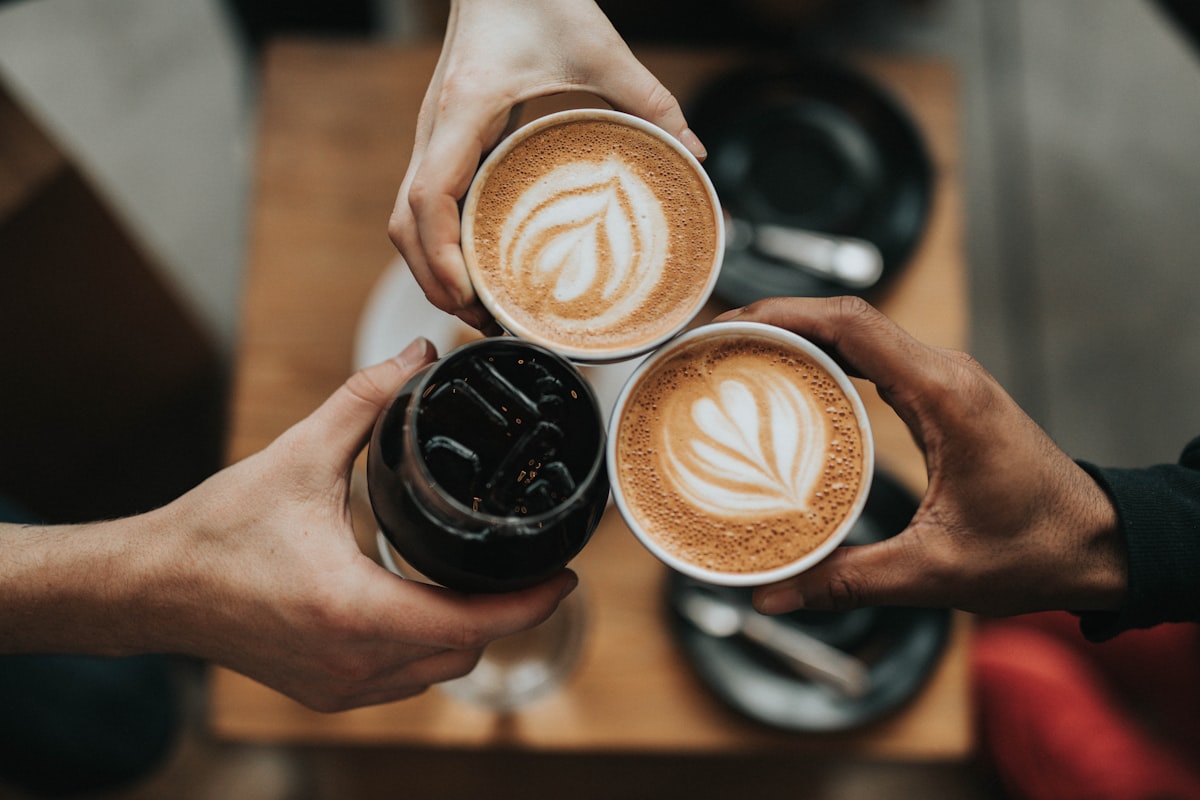
Coffee reading — or tasseography, to use the older term — did not appear overnight. It is a practice that took shape over centuries, at the meeting point between the habit of drinking coffee and the very human desire to find meaning in the random shapes around us. This article does not show you how to do a reading (for that you have the base guide); instead it looks at where the tradition comes from, how it spread around the world, and why it works — honestly speaking — more as a mirror for your thoughts than as a method for predicting the future.
The origins of tasseography
The word "tasseography" comes from the French tasse (cup) and the Greek graphein (to write) — literally, "writing from the cup". The modern practice is closely tied to the spread of coffee from the Arabian Peninsula and the Ottoman Empire, starting in the fifteenth and sixteenth centuries. Coffee brewed Turkish-style, without a filter, leaves a fine, rich sediment at the bottom of the cup — exactly the material a reading needs.
The habit of looking for meaning in what a drink leaves behind is, however, far older and far more widespread than coffee. Before it, many cultures read tea leaves, wine dregs, or other traces. Anthropologists describe this impulse, broadly, as a form of divination through patterns: humans have always searched for regularities and messages in seemingly random things. Tasseography is, in essence, one of the gentlest and most domestic forms of that impulse — it asks for no altars or elaborate rituals, only a cup and a few minutes of attention.
It is also worth noting that the Turkish cup was, from the very start, the ideal medium for this practice: the fine grounds settle evenly on the walls, and the narrow shape of the cup concentrates the traces, giving the eye enough material without overwhelming it. In this way a whole visual language gradually took shape, passed down orally, with no manuals and no written rules — each family and each region adding its own small touch of interpretation.
How it spread around the world
As coffee travelled, so did the habit of "reading" it. The tradition settled most deeply in a few large cultural areas:
- The Middle East: here, in the Ottoman coffeehouses, unfiltered coffee and the shared moment over a cup created the perfect setting for a reading. Reading the cup became a social gesture, part of hospitality.
- The Balkans: in Greece, Romania, Serbia, Bulgaria, and neighbouring countries, "reading the coffee" was passed down through generations, often from a grandmother to a granddaughter, as a small family ritual.
- Western Europe: the fashion for cup readings entered the salons of the eighteenth and nineteenth centuries, especially as tea-leaf reading, becoming an elegant pastime.
Each culture added its own dictionary of symbols and its own accents. That is precisely why there is no "official book" of tasseography: there are traditions that resemble one another in essence but differ in the details. Immigrant communities carried these customs onward, so that today you can find coffee reading on almost every continent, in local variants.
How it works psychologically
If you look at tasseography honestly, its "mechanism" is not supernatural but psychological — and that does not make it any less valuable. A few well-documented phenomena explain why a cup of coffee can trigger a surprisingly useful reflection:
- Pareidolia: the mind's tendency to see familiar shapes (faces, animals, objects) in random patterns. It is the same mechanism that shows you a rabbit in the clouds.
- Projection: when you look at an ambiguous shape, you fill the gaps with what already concerns you. So the cup becomes a surface onto which you project your own thoughts and emotions.
- The Barnum effect: we tend to feel that general descriptions apply to us personally. That is why an "open" symbol can seem astonishingly precise.
- Narrative-making: the human brain searches for stories. By linking a few symbols into a story, you sometimes clarify what felt confused.
In other words, the cup "knows" nothing about your future. Its value lies in giving you a structured excuse to pause, look inward, and put into words what was already moving, unclear, in your mind. It is a mirror for your thoughts, not a window onto the future — and that is exactly how it deserves to be used.
Acknowledging this psychological dimension does not spoil the charm of a reading — on the contrary, it makes it more honest. Once you know that you are the one giving meaning to the shapes, you become more attentive to what you choose to see and why, and the reflection gains depth. Far from being a weakness of the practice, it is precisely this awareness that turns it into a useful tool for self-knowledge.
The reading as a moment of introspection
Much of the tradition's power comes not from the symbols but from the ritual. Drinking the coffee slowly, turning the cup over, waiting a few quiet minutes — all of this creates a rare pause in the rhythm of the day. In that short interval, attention shifts from outer worries to the inner world.
Over time, the reading was also a deeply social gesture. Over a cup of coffee, people told each other about their lives, shared their fears and hopes, and listened to one another. "Fortune-telling" was often the pretext for an honest conversation — a gentle way to ask "what is on your mind?" without saying it directly. Seen this way, the coffee ritual resembles an early, warm form of mindfulness and emotional support among those close to us.
This is probably why the tradition has survived so many centuries: not because it predicts the future accurately, but because it offers a framework for attention, connection, and introspection — things we need in any era.
The tradition today
Today, coffee reading lives on in many forms. There are still grandparents and friends who "read" the cups at a gathering, but there are also themed cafés, workshops, and apps that offer assisted interpretations. Technology has demystified the practice: more and more people approach it in a relaxed way, as a game of self-knowledge rather than a source of prophecies.
And that, in fact, is the healthy part. The better we understand where the tradition comes from and how it works, the more honestly we can use it: as a tool for reflection and a quiet moment, not as a certainty about what will happen to us. If you want to move from history to practice, see the beginner's base guide. And if you would like a guided reading of your own cup, you can try one directly on NexusGrounds — upload a photo and receive a thoughtful reading, designed as a starting point for introspection.